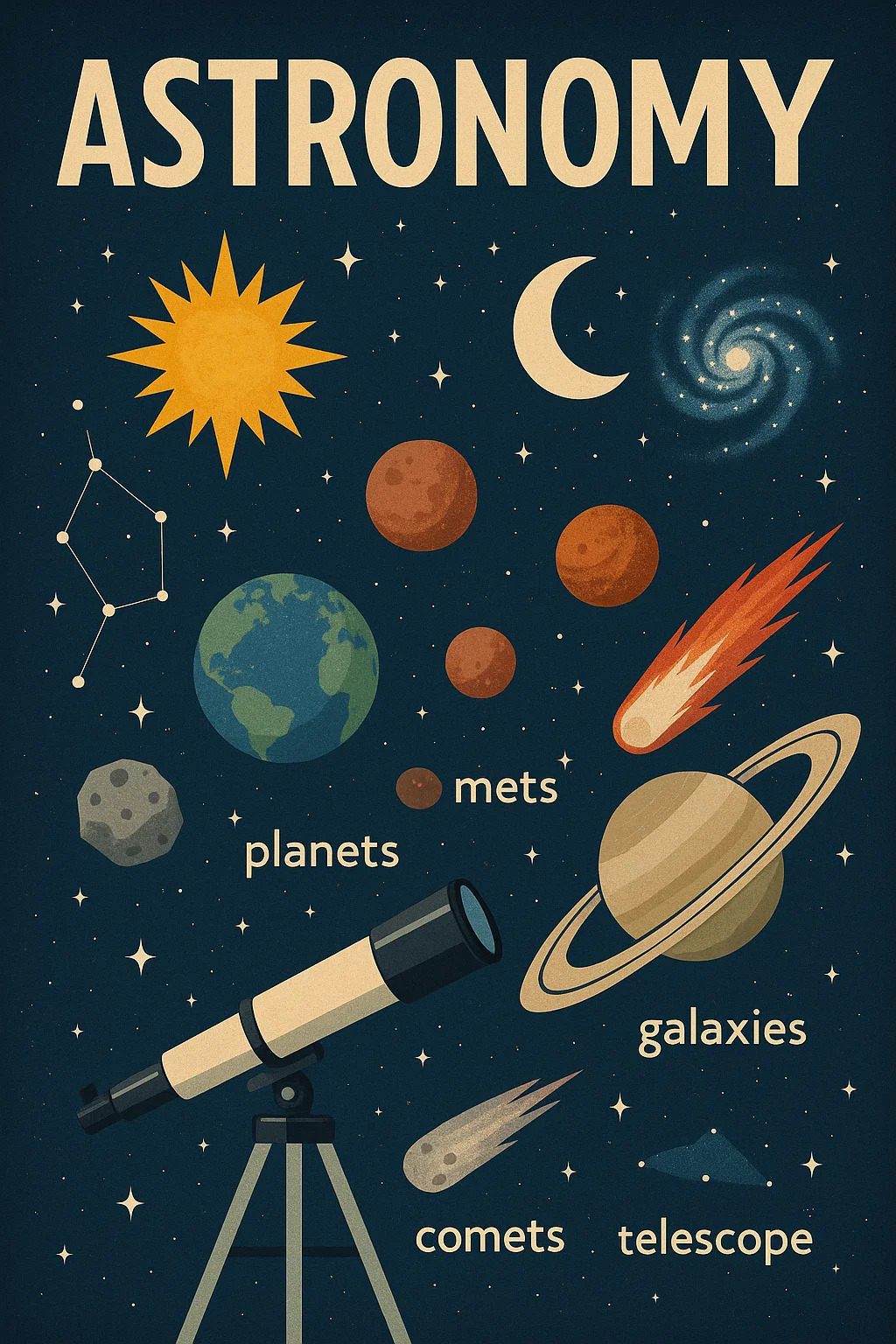
Astronomy is the natural science that includes study of celestial objects and all phenomenons that occur in the cosmos beyond earth’s atmosphere. The celestial objects include stars, planets, comets, asteroids etc and their larger clusters like galaxies or constellations etc. We are able to see many celestial objects by naked eyes whereas to see the rest of distant objects we require telescopes.
The celestial objects influence each other with their gravitational force, radiations, relative motions and own motions. Thus their position in the sky above us is seen changed due to regular relative motions. That is why we see changed positions of different constellations on daily basis and also cyclic in intervals. Other phenomenon like transits of comets, asteroids and planets are also associated with relative positions of celestial bodies. Even the biological processes of living beings on the Earth are influenced by the relative position and forces of other celestial bodies. Sun is the best example which is the only source of energy to support life on the Earth.
In our solar system our planet Earth is placed in an orbital path around the Sun and moves around it under its gravitational force (revolution), as well as rotates on its own axis (rotation). On the other hand, Earth's only natural satellite is the Moon, which revolves around it under the influence of its gravitational force, but only the same side of it is always visible towards the Earth because its rate of rotation is tidally locked, so that it becomes synchronous with its rate of revolution (the time required to complete one orbit). In other words, whenever the Moon revolves around the Earth, it rotates once in exactly the same amount of time and hence only one side of it is visible towards the Earth. The same forces that create tides in Earth's oceans from the Moon's gravitational pull, also act on the Moon's solid body.
We see daily rise and set of Sun and Moon because of relative motions of the Earth with them, so is the case with between other celestial bodies. The solar and lunar eclipses are also associated with the relative position of the Sun, the Moon and the Earth.
Different celestial objects including our own planet exert gravitational force according to their mass and size and even influence each other by that. The Moon is positioned and moves under the Earth’s gravitational pull but its own gravitational force along with movement and changes in relative distance with the Earth influence the natural phenomenons on the Earth. The daily tidal movements in our ocean waters are an excellent example of Moon’s gravitational influence on the Earth’s natural phenomenon. Our traditional time keeping and calendar and weather forecasts and other miscellaneous information like positions of constellations and planets and their predicted effects are based on the knowledge of astronomy.
Night sky watching or day time observations of celestial objects always fascinate us. Likewise, is our curiosity for eclipses, identifying planets and constellations and their positions. Sometimes we need to be cautious about ways and means of watching the celestial objects and their phenomenon like watching the eclipses and watching the sun, and we require certain tools and follow methods for safe watching.
In this section we shall learn about celestial bodies, planets, constellations, sky and space phenomena through various activities.
* Solar Eclipse
* Stars In the Sky
* Changing Positions of Planets