Chlorine is used as a disinfectant in drinking water supply, to kill the microbes and other pathogens. For domestic use the amount of residual chlorine at the point where the consumer collects water should be between 0.2 to 0.5 milligram per litre. This activity is to help common masses and learners to test the range of residual chlorine present in a water sample.
The quickest and simplest test for residual chlorine is the Ortho-Toluidine indicator test. In this test when Ortho-Toluidine indicator reacts with chlorine that is present in water, it produces a dye of distinct magenta/purplish-red colour and the darkness of that colour is proportional to the amount of chlorine present in water. With the help of a standard colour comparator chart and given reference range of chlorine we can compare the colour change in corresponding water sample and know the concentration of chlorine present in it.
Test tube or a small measuring glass vessel, dropper, Ortho-Toluidine indicator, standard residual chlorine color comparator chart.
1- Take 10 ml water sample in the test tube and add 1-5 drops of Ortho-Toluidine test reagent in it (Remember that for each water sample the same amount of water and same amount of Ortho-Toluidine indicator has to used).
2- Wait for 30 seconds while any change occurs in the water color
3- The strength of changed color is measured against standard colors on a chart to determine the chlorine concentration. Stronger the colour, higher the concentration of residual chlorine in the water.
â— Record the details of the sample source and assign a code to it
â— Record the concentration of residual chlorine for each sample
A sample of data table and idea of how to enter data is given here for reference -
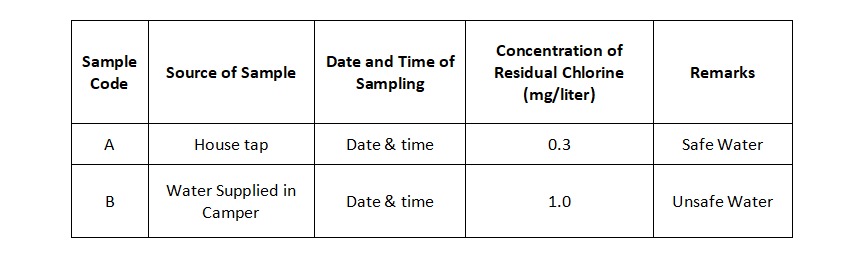
Record the concentration of residual chlorine in milligram per liter (mg/lt.) for each of the sample water and draw inferences like average concentration, minimum, maximum etc. At a grassroots level inference you can make a map of residual chlorine concentration recorded from different sources (test sites) in your area. For that you may also need to record the location of each sampling.
â— Chlorine helps in disinfection of water.
â— Residual chlorine is the amount of chlorine that remains in water after a certain time period of treatment of water with chlorine.
â— Residual chlorine is good for health when it is within permissible limits.
â— What would be the result if you test the residual chlorine of a water sample at the site (of its collection) and later at different time intervals after bringing it to the test facility?
â— Which of the drinking water would be better for health – one that is chlorinated and other that is not chlorinated? Why?
â— What are the local / traditional practices in your area by which the drinking water is treated to make is safe for consumption?