By determination of the crown cover of trees we can infer many aspects like dominance, competence, association, density, foliage, branching, stratification etc. The most important function of the crown of a tree is to expose its leaves to the sun for performing photosynthesis. The variations in crown cover of a tree species at different time and different places (i.e. temporal and spatial variations) reflects its competitive ability during growth and adaptive capability to withstand weather and climate changes. Poor crown cover of trees or poor canopy cover of the stand of trees is an indication of the degradation while dense crown and dense canopy cover is the indication of rich and healthy tree diversity.
In this exercise we shall learn how we can estimate the crown cover of a tree.
â— Plane Mirror,
â— Marker,
â— Ruler,
â— Graph Paper,
â— Coloured pencil,
â— Compass
1- Taking a plane mirror horizontally in your hand (so that the reflection of tree above, is seen in it), walk away from the tree towards a direction (let it be north).
2- Stop where the leaves or branches of the tree are no longer visible in the plane mirror.
3- Ask a friend to call out when you reach the edge of the area covered by the leaves above.
4- Place a marker at this point.
5- .Repeat the above process for other directions viz. North-East, East, South-East, South, South-West, West, North-West).
6- Measure the distances from the markers to the tree trunk with a meter ruler and note in the data sheet.
7-.You may make sketches of trees and/or take photographs for further reference.
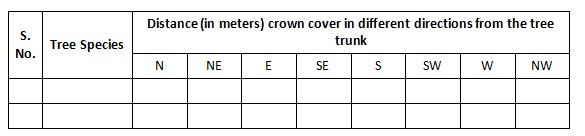
You can tabulate the distance of crown cover in different directions in a table, for example, as shown here -
* Plot your result on a graph paper. First decide a scale, let’s take 1 cm on the graph for 1 meter on the ground.
* From the center of the graph paper, first mark eight directions (that you have determined) and in each direction draw line proportional to the distance recorded in your table (i.e. distance of each marker from the stem of the tree).
* Join the outer ends of the lines that were drawn from center, with straight lines (you get a polygon like diagram)
* Count the squares and half squares of the graph paper that come within the polygon diagram
* You may avoid less than half parts of squares.
* Now adding the number of complete squares and half squares separately, calculate the approximate area covered within the polygon figure, in square centimeters.
* Each 1cm square represents 1m square; accordingly calculate the approximate area of crown cover in meter squares.
* Find out and compare the crown cover of different trees occurring in your area.
* You may calculate the approximate canopy cover of the landscape by adding all crown covers.
â— You may present the crown cover for each tree species or may interpret the data through mathematical and statistical analysis.
â— You can present your data species-wise or crown cover class-wise or in any other form as per requirement.
â— Sketches of the tree shapes and photographs would help in making better inferences.
â— Different species of trees or even different individuals of same species have different crown cover according to their growth.
â— The crown cover reflects the dominance of a species in occupying space in an area.
â— Crown structure and cover influences the foliage (leaves) in trapping the sunlight for photosynthesis.
â— How do different species influence each other in an area through their crown cover? Explain with example.
â— Can you determine crown cover of a shrub? Try yourself and find out.
â— Observe the changes in the crown cover of a tree during different seasons.
â— What is crown fire?