When the temperature in clouds drops down to a degree that it triggers conversion of condensed vapour into liquid drops or frozen form that fall down on the earth, which is called precipitation. The precipitation may occur in various forms like drizzle, rainfall, snow, hail and sometimes cloud burst. Rainfall is one of the major forms of precipitation. Rainfall occurs in various parts of the earth during different times of the year.
Rainfall is one of the important environmental factors that influences occurrence and distribution of species and ecosystems, feeds the surface water bodies, helps in groundwater recharge. Rainfall is a major component of the water cycle on the Earth that helps in cycling of water from oceans to terrestrial areas and vice versa. Rainfall is an important indicator of vegetation types, animal types, ecology and most importantly, the weather & climate of an area.
Monitoring of rainfall is an important aspect to understand the weather and climate of an area and the simplest tool to monitor rainfall is the Rain Gauge. Rain gauge consists of a circular funnel which collects the rain into a graduated measuring cylinder. The graduated measuring cylinder is kept in a cylindrical vessel and the funnel is fitted on its mouth such a way that its tubular end portion put inside the graduated cylinder. A standardized design of rain gauge is used throughout the world for rainfall measurement and according to that the funnel of 203 mm (8 inch) diameter is used. One can easily assemble own rain gauge with the locally available material.
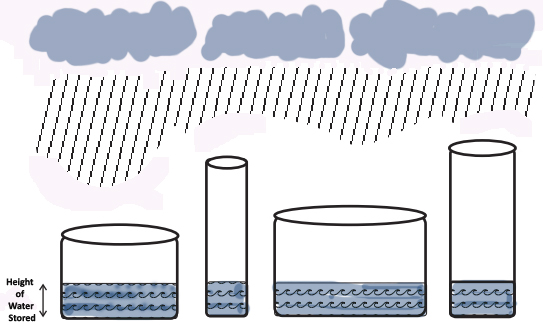
The amount of rainfall is expressed in millimeter (mm) and is normally measured for 24 hrs for calculation. This means that if the rainfall at a particular place stands there without seepage in the ground and evaporation, then the total millimeters of the standing water is the measure of the rain fall. Normally 1 mm of rainfall (collected in the graduated cylinder) is equivalent to 1 ltr of rain water volume per square meter area. With average annual rainfall of an area (i.e. total rainfall in a year) one can estimate the potential of rain water collection in reference to any building or area.
Since wind is one of the greatest causes of error in rain gauge measurements, the best placement for the rain gauge is on a post as low to the ground as possible. Wind blowing across the top of the gauge creates an effect that causes raindrops to be deflected around the gauge. Because wind speed generally increases with height above the ground, the lower the rain gauge, the less effect the wind should have on it. In standard way, the top of the rain gauge is kept about 0.3 meters above the ground with no objects nearby that may affect its operation. The rain gauge is installed in the open area, the more open place, the better it is placed.