Soil porosity influences various physico-chemical and biological features of soil, like water drainage, water holding capacity, gaseous exchanges, microhabitat of soil organisms, penetration and growth of plant roots etc. Most importantly, the porosity is determinant of the availability of ‘Capillary Water’ that is primarily available to the plant roots. Porosity itself is determined by combination of other soil characteristics like structure, texture, organic carbon etc.
Soil porosity can be determined by estimating the pore volume i.e. volume of the space available between soil particles, and is expressed as a percentage of the total volume of the soil material. Soil porosity is an important factor in areas where drinking water source is groundwater and the ground has drainage issues.
â— Glass beakers of 250 ml volume,
â— measuring cylinder of 100 ml volume (Alternatively you can take any wide mouth vessel of known volume and another graduated vessel of known volume)
1- Fill the beaker with the collected soil sample to a definite volume (for example, let us fill it up to 200ml volume), keep stirring the beaker gently so that the soil sample gets filled properly up to the marked volume.
2- Take the measuring cylinder and fill it to 100 ml with water.
3- Now from the measuring cylinder slowly and carefully pour the water into the beaker in which soil sample is filled, keep pouring the water slowly until it reaches to the level of filled soil.
4- Pour slowly so no water spills out of the beaker. Record exactly how much water was used.
5- If the water level goes down from the level of filled soil then add more water to bring it to the same level.
6- Finally record the amount of water used to fill (saturate) the soil up to its top surface.
7- Follow the above process for every soil sample whose porosity has to be determined.
â— Record in the data table, the amount of water used to saturate different soil samples.
â— Use the following formula to calculate the percent porosity of the sampled soil -
â— % Porosity = (Amount of water added to soil sample / Volume of soil sample) X 100
â— A sample of data table and example of data entry is shown here; you can design your own data tool to record the observations
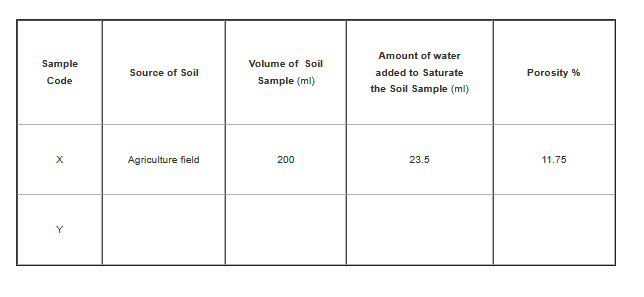
â— Derive your results regarding porosity of different soil samples and other quantitative and qualitative interpretations based on the data compiled.
â— Different soil types have different pore spaces between their particles and accordingly possess the ability to hold the water.
â— The underground seepage and recharge of water is affected by the porosity of soil.
â— Make a mixture by adding different soils together to make the soil having desired porosity and check whether it serves better in holding water and air and helps plants to grow better.