The bacterium called Escherichia coli (E. coli) is naturally found in our digestive system (large intestine) and plays role in keeping it healthy. But if the same bacterium enters our body with water or food, it causes severe health impacts through impairing the functions of the digestive system. Presence of E. coli in the water is an indication of water contamination with fecal matter and the contaminated water needs to be treated properly before consumption.
The simplest and quickest method for detecting presence is the Vial Culture Test (also called H2S Strip Test) in which the sampled water is cultured with a pre added growth media in a vial for 24 hours at room temperature. The vial contains a paper strip which is soaked with the growth media that would help the E. coli bacteria to further multiply. The water sample filled in this vial if has any E. coli then the colour of water will change to indicate the presence of E. coli in it.
H2S test Vial (containing paper strip laden with growth media)
1- Collect the water sample in the H2S vial directly and fill it up to the brim and immediately screw the cap of the vial,
2- Place the vial in dark place at room temperature,
3- Keep the vial for 24 hrs and then examine the change in sampled water,
4- If the sampled water color changes to black, it indicates the presence of E. coli in it.
5- Precaution: Keep your hands clean before and after handling the sample. After the test carefully discard the sample in a drain).
Record the presence and absence of E. coli in the water samples collected in your area. The data can be analysed through mathematical or statistical means to derive inferences. A sample table is given here for example to collect the data -
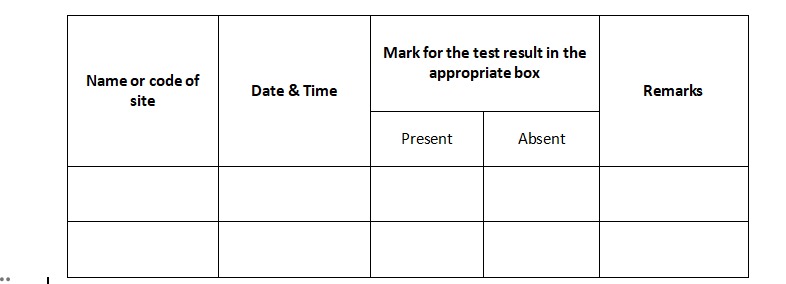
Water sample detected with fecal Coliform in the referred area are identified. Apart from the mathematical or statistical inferences you can prepare the E. coli distribution map of your area so as to assess the area affected by open defecation / water contamination by fecal matter.
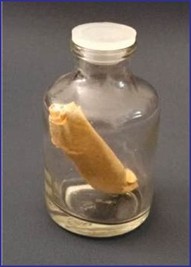
Figure: Coliform Culture Vial (H2S Vial)

(a)E. coli absent (b)E. coli present
â— Fecal bacteria contamination of drinking water,
â— Microbes are also found naturally in the human body
â— E. coli naturally present in the distal part of the gut i.e. large intestine in human beings play helpful role,
â— Open defecation is one of the major cause of fecal contamination in surface water bodies
â— For positive test results, try treatment of the water by alternative means and then again conduct the test of the treated sample to verify whether the E. coli contamination has been controlled or not.
â— Why it is recommended to wash hands after defecation with soap or ash?
â— Why it is recommended that to take water from a vessel one should use a ladle or vessel having long handle?
â— What are the materials used to filter water in households? Explore the traditional & modern means of water treatment for safe consumption
â— The H2S test medium contains Sodium thiosulfate as a sulfur source and ferrous sulfate or lead acetate as an “indicator. Bacteria of fecal origin like E. coli are able to reduce the sulfur to sulphide as H2S. The produced H2S reacts with the indicator and forms a black precipitate of ferrous sulfide or lead sulfide.