Vermicarium (wormery) is an artificial safe home for worms. The vermicarium is a kind of container having variable height, width and length with its top open for transferring soil, earthworms, water and other required material into this and at least one side transparent. With the help of vermicarium one can understand the habitat conditions of soil worms.
Here we are describing how we can make a vermicarium for keeping earthworms and understand their lifecycle by closely observing them. Earthworms play very important role in maintenance of soil characteristics through transforming the soil nutrients and organic matter. They also play important role in turning the soil to-down and also influence its porosity, water holding capacity, drainage of water and movement of minerals.With the help of vermicarium we can see how earthworms make their burrows, how do they feed, what they feed upon, how do they do movements, how do they excrete and how do they interact with each other and other etc. excretion, interaction etc
A Vermicarium It is a closed container where the top is kept open for aeration and transferring soil and organic material for earthworms.
1- Collects different types of soils (sand, silt, clay etc) having different colours and decomposing plant products.
2- Puts the soil types one by one in the form of layer in any order in the container (This is basically meant to see later on what changes occur in the soil when earthworms transform these soils).
3- Put the decomposable plant products such as dry leaves, roots, vegetable and fruit peels, little cow dung or fecal pallets of goat etc in the top layer.
4- Spray little water to moisten the material filled inside the container.
5- Release some earthworms (you can count their number) on the top layer in the container.
6- Since earthworms avoid light, the vermicarium needs to be kept either covered or at a dark place so that earthworms are not forced to hide and they can perform activities naturally.
7- From time to time the naturalists can bring the wormery for short time to a lighted area and observe the behavior of the earthworms.
8- The transparent walls of vermicarium allow you to observe the inside physico-chemical and biological changes as if you were seeing in the vertical section of the ground.
9- At weekly intervals see how much deeper the earthworms have reached and how are they transforming the organic matter and soil.
10- At weekly intervals see the changes occurring in soil structure and colour (also observe which layer of soil is transforming first)
11- See if the number of earthworms has increased; can you see their eggs and juveniles too?
12- Over a month or, two one can observe the transformation of the decomposable material as well as soil into vermi-compost (also called organic manure) which is highly fertile and good for plat growth.
13- Record the transformation of soil and organic material into vermi-compost over a time period (Journey towards vermi-compost).
14- You can bring out the material after its complete transformation and separate out the earthworms (now they are more in number and with them you can make multiple vermicarium or release some of them in your garden soil).
Note – There are different earthworm species occur in the environment. You may try experiment with different species and make a comparative record of each. Remember, each species of earthworm irrespective of their comparison is important for the nature as well as to us.
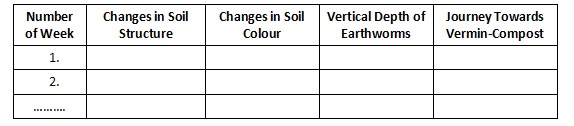
â— You can record the observations of earthworms in a data format. A sample of data sheet is shown here; you can design your own data sheet as per requirement.
â— You can set the experiment in different seasons and can see what differences you get in the same parameter of observation during different seasons.
â— You can test the physico-chemical characteristics of the soil before release into the vermicarium and again after it gets transformed into vermi-compost.
You can analyse your data quantitatively and qualitatively and make interpretations accordingly.
â— Earthworms perform very important role of transforming organic matter and soil into nutrient rich compost.
â— Earthworms also require certain conditions to live in the soil. Without that they can’t survive in the soil.
â— Earthworms are sensitive to temperature and light, hence we have to be careful for them while doing any lightening or heating on to the ground.
â— Absence of earthworms or, decrease in their number in any soil is an indicator of the poor quality of soil.
â— Have you seen whether the earthworms have eyes or not? How do they see and change the direction during movements?
â— Do the earthworms have lungs? How do they breathe?
â— What is vermi-compost? How it is produced? What does it is composed of?
â— Test the vermi-compost for its texture, consistency, porosity, water holding capacity, and nutrients and compare with same parameters of your local soil sample.
â— Find out whether growing a plant only in vermi-compost is good or growing it in vermi-compost mixed soil? What should be the proportion of vermi-compost and soil to grow a plant?
Earthworm diversity in India:
In India, including the islands of Andaman & Nicobar and Lakshadweep, 452 species / subspecies of earthworms belonging to 71 genera are known. Out of them 89% of species/subspecies and 71% of genera are endemic (i.e. they are confined to Indian parts where they occur and nowhere in the world). 57 species of earthworms in India are exotic (i.e. brought from other geographical areas other than India). The scientific exploration of earthworm’s diversity in India began in nineteenth century)
Are there specific species of earthworms used for vermi-composting?
Earthworm diversity varies with soils and choosing a native species for vermi-composting is best. Your native species are best suitable to your local environment and adapted to survive. There is no need to import any particular species for making vermi-compost. In India local species mostly used in vermi-composting are Perionyx excavatus and Lampito mauritii.
To know more about earthworms of India you can visit the following website - https://earthwormsofindia.com/