Light is an important abiotic factor in a water body which helps in photosynthesis in aquatic plants. If the photosynthesis process is obstructed by any means, the production of food at primary level and the subsequent food chains get affected. In a water body the aquatic plants are distributed up to the depth to which the sunlight reaches. In the same manner, the visibility in a water body or transparency is possible up to the depth to which the sunlight or light from any other source reaches.
Transparency in any water body can be measured with the help of a simple device called 'Secchi Disc'. Secchi Disc is a metallic plate having alternate black and white quadrants painted on it. The metallic material is for making it heavy and not to float in water if it is lowered in any water body.
The working principle of the Secchi disc is that it that when it is lowered in the water it is visible up to the depth to which the light would be reaching at that time and it becomes invisible if lowered further deep. It becomes visible again when it is pulled up. The depth is measured by measuring the rope with which it is tied. The average of the depth of disappearance and reappearance is the depth of penetration of light or the transparency of water at that time.

Figure: Secchi Disc Assembly
â— Secchi Disc
â— Rope
â— Measuring tape
1- Tie the rope at the hook of the Secchi disc and release it slowly into the water,
2- Lower the Secchi disk very slowly into the water until it disappears from the view,
3- Mark the point at the rope (at water surface level or at a static point from where it is lowered) when the disc becomes invisible,
4- Now very slowly pull the rope to lift the Secchi disc and stop when the disc is visible again,
5- Mark the point at the rope again when the disc reappears,
6- Take out the Secchi disc and calculate the transparency (depth of light penetration) of the water body

Figure: Immersion of Secchi Disc in Water Body
â— The observations of depths measured can be tabulated systematically and further calculations can be done. a sample table and data is given here for recording the data and calculati
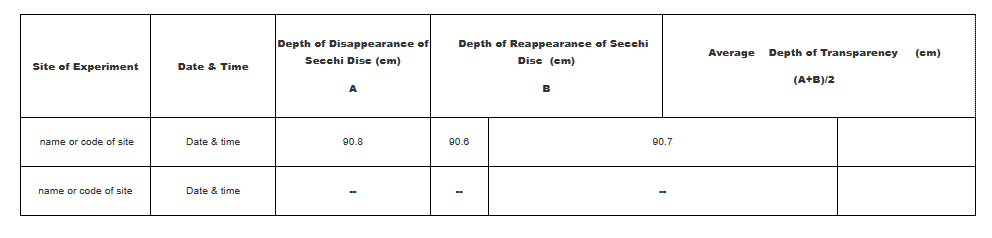
â— For each point the transparency is calculated.
â— The transparency recorded at different locations in same water body or different locations in different water bodies also referred as transparency at that point.
â— Average transparency of a water body can be found by calculating the average of the transparency measured at all points at that water body.
â— The phenomenon of transparency in a water body is corresponding to the light penetration in the water.
â— Transparency in water is an important factor that affects photosynthesis and consequently the food chain, food web as well as distribution of other organisms in water body.
â— Transparency is affected by the turbidity or the amount of dissolved or suspended substances in the water body.
â— What are the factors that affect the transparency of water? Find out for the water body in your locality.
â— In a water body find out transparency of water at different locations/zones and find out differences in transparency of different zones (viz. at different locations near shore, at different distances in the water body from the shore. What do you find out? What are the reasons behind that you find out?
â— What would be the observations if you measure transparency in a water body at the same place at different times of day and/or in different seasons or at random or periodic intervals?
â— What would happen if persons having different eyesight measure the transparency of water at the same point?
â— The most transparent river in India is Umngot River which is also called Dawki River. It’s riverbed is clearly visible even from the far above distance from the water surface. However the transparency does not remains the same and the river is most crystal clear from December to March. Umngot River originates from the East Khasi Hills and travels for about 96 kilometers passing through a small town Dawki and villages Shnongpdeng and Umwah Nongbah, and after making a dividing line between India and Bangladesh it later joins the Kaladan River in Bangladesh.