Pooter is a simple technique to catch small insects in a safe manner. It enables the person to catch small insects, which later can be kept in the terrarium and observed for their morphology, body parts and behavior. With the help of pooter, the insect is slowly pulled (sucked) into its container. There remains no way for the insect to move out of the container. After a few insects are drawn into the container, they can be transferred into the terrarium for observation. After observation they can be released back conveniently into the ambient environment.
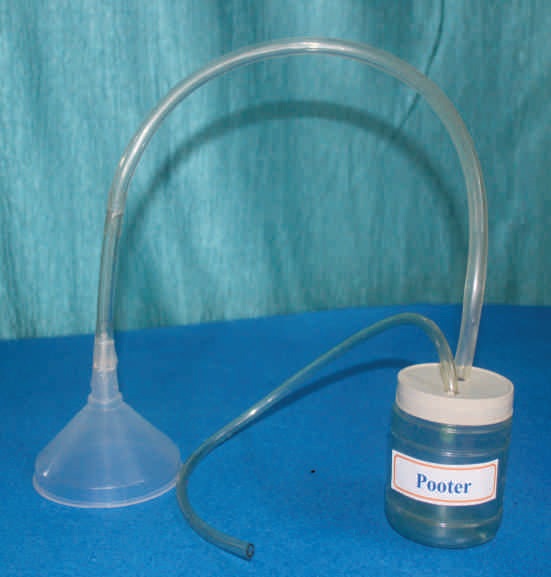
Image: Pooter
A pooter
You can make your own pooter device.
â— Locate the small insect you want to collect and quickly put the funnel of pooter on it such that it is trapped in the funnel.
â— By another tube connected to the container, suck the air out so that an air suction would be created in the container and through it in the tube connected with funnel, so that the insect trapped in the funnel would be pulled in the container.
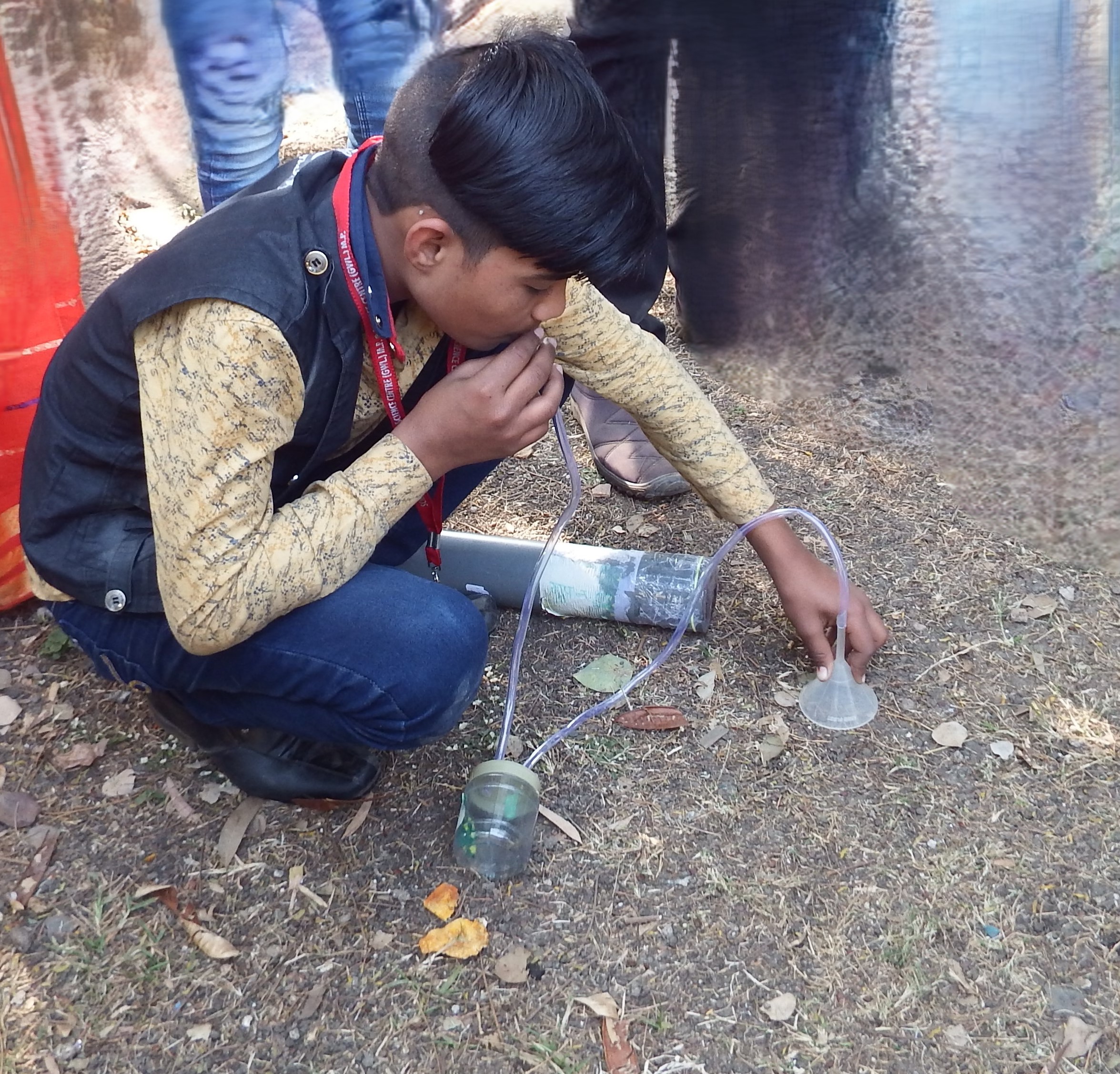
Image: Use of Pooter for Collection of Insects
â— Transfer the insect from the container of pooter to the terrarium for further observation, where it is kept with provisions of food, water and safety.
â— Observe the insect in the terrarium without handling and disturbing it and record your observations of in the data format.
â— You can make sketches of the insect and also take photographs of it for making further purpose.
â— After the study the trapped insect is released back into its habitat.
â— You can collect more numbers of an insect species or many insects of different species for observation & study purpose.
Data collection and analysis –
â— You can catch and study a wide range of insects and make records of their morphology, behavioral pattern and other characters in a systematic manner.
â— Comparative analysis of the collected information can be used to make numerical inferences and illustrative records like charts and posters.
â— Record your observations systematically in a data format. An example of data table is given here; you can design your own data table according to the need.

You can present your observations in the form of quantitative and/or qualitative data.
Hand drawn sketches and photographs will be an additional record to display.
â— Pooter is an effective and safe tool to catch small insects for study.
â— Body structure and behavior of small insects can be studied through the pooter and then in terrarium.
â— How do insects communicate with each other? Do they have any language in any manner?
â— How do grasshoppers produce clittering (stridulating) sound?
â— How do insects visualize the size and distance of any object?