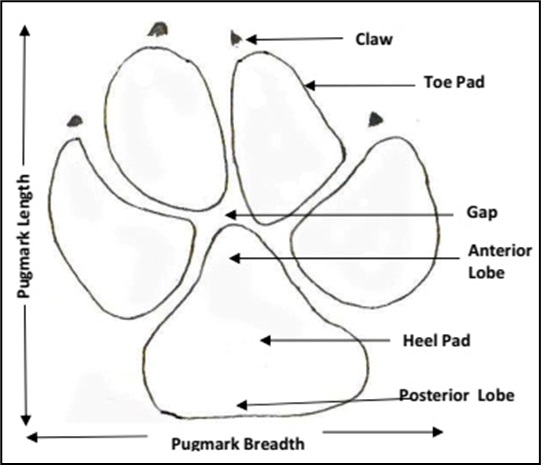
The word Pugmark means the mark left by the foot of the animal during locomotion, therefore normally it is called footprint. Sometimes we are unable to see many animal species that exist in an area, due to many reasons like our own timing of visit, their timing of movement in their territory etc. In case of wild animal species like that of cat family, dog family, rodents, small mammals, birds and reptiles etc sometimes we find only their indirect evidences i.e. footprints, fecal matter, urine marks, body parts, markings on trees and ground, hairs, ground digging, and calls. Footprints are one of the easy indirect evidences of the presence of an animal species in the area. We can infer many aspects about animal species based on their footprints.
Investigating the presence and identification of animal species in an area by their Pugmarks (footprints) follows the process of indirect evidence. The exercise involves tracing the pugmark found in the area on the paper and identification of animal species with the given key of pugmarks of different species. The collection of pugmark tracings can be used as a reference key to identify the unseen animal species by their pugmarks. Through practice of pugmark documentation and analysis we can also infer their population, sex, age, behavior, activities and role in the local ecosystem. This exercise is not only helpful in generating awareness and creating knowledge base about diversity of animal species in an area, but also to understand their demographic features (i.e. male-female-juvenile counts), population size, behavior (movement, direction, speed, frequency etc). Through this exercise one can understand how different species play their role in an area and why it is important to conserve them to maintain the ecological health of the area.A key of pugmarks of some animal species is given for reference.