Soil structure depicts the arrangement of solid particles of the soil and of the pore space between them. Apart from the natural aggregation of soil particles the soil structure also affected by its natural formation and also by the soil management practices. Each individual unit of soil structure is called a ped (aggregate of soil particles as a result of pedogenic process). The natural organisation of particles in the form of discrete units (peds) is separated by pores or voids.
Based on the aggregation of soil particles the soil structures are categorized as follows -
Granular - Granular structure is consists of the aggregates having equate and just about spherical shapes. Water circulates very easily through such soils. They are commonly found in the A-horizon of the soil profile.
Blocky - Blocky and subangular blocky structures are formed when soil particles cling together in nearly square or angular blocks having more or less sharp edges. Relatively large blocks indicate that the soil resists penetration and movement of water. They are commonly found in the B-horizon where clay gets accumulated.
Prismatic and Columnar - Prismatic and columnar structures are formed by arrangement of soil particles into vertical columns or pillars separated by miniature but definite vertical cracks. Water circulates with greater difficulty and hence drainage is poor. They are commonly found in the B-horizon where clay gets accumulated.
Platy - Platy structure is made up of soil particles aggregated in thin plates or sheets, piled horizontally on one another. Plates often overlap, greatly impairing water circulation. Such soils are found in forest in the A- horizon, and in clayey soils.
Massive – This type has no distinct structure. It is hard to break apart and appears in very large clods.
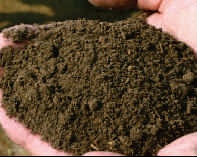
1-Take out a sample of undisturbed soil from any soil horizon with the help of shovel or trowel.
2- Look closely at the soil and examine its structure (aggregation of soil particles) either by naked eye or with the help of magnifying glass.
3- Match the structure of the sampled soil with the keys shown in soil structure leaflet.
4- Determine the type of soil structure of the sampled soil and record in the data sheet.
â— Record the soil texture test results in the designed table or data format. A sample data table is given for example –
â— Record the soil structure of different samples in a data sheet. An example of data table is given below. You can modify or redesign the data table according to the need.
Table to record the soil structure categories of different horizons –
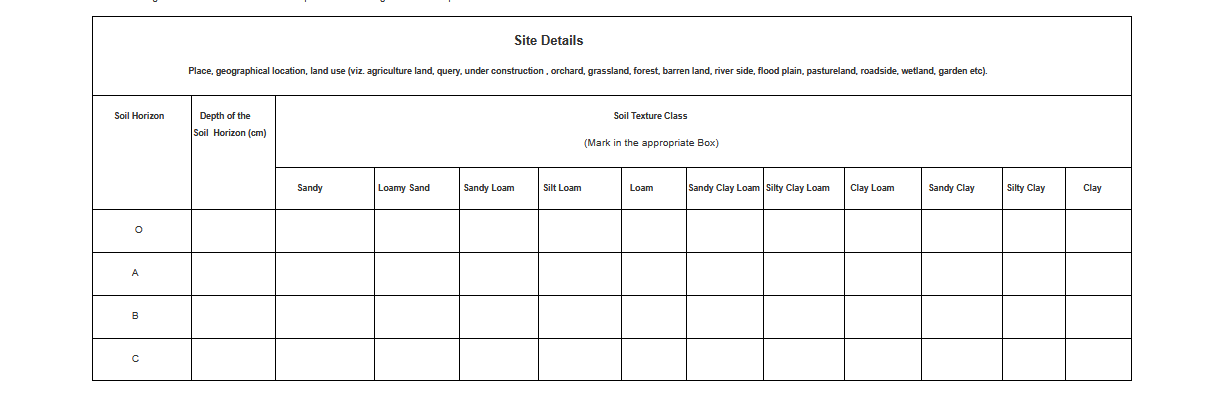
â— Present your results in the form of numerical data in the form of quantitative and/or qualitative characteristics. Various interpretations can be done through mathematical and/or statistical calculations.
â— Photographic evidences of the landscape surrounding the sampling site will be useful for further reference.
This activity helps in finding and interpreting the facts like -
â— The unit of soil structure itself is composed of aggregated particles and each unit is called a ped.
â— The presence of air spaces in the form of pores or voids in the soil structure regulates its moisture and water holding capacity.
â— Examine the drainage (movement of water) in soils having different structures.