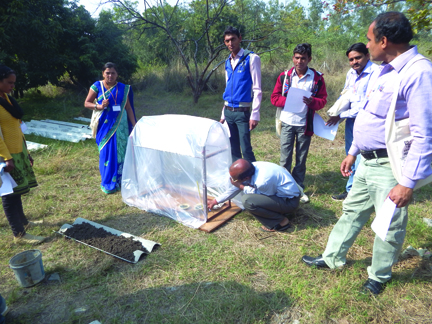
Green house is a technique to maintain temperature and humidity of the inside environment of an artificial chamber which is meant for growing vegetables, flowers and other type of plants under regulated conditions. The walls and roof of greenhouse are made of glass or transparent sheets so that it allows the sunlight to enter but obstruct them to reflect back, at the same time it traps the geothermal radiations emitting from the earth inside it and hence helps in maintaining the optimum temperature and humidity inside when the conditions in the outside environment are not stable. Green house is also useful as a nursery for germination of seeds and healthy growth of their saplings. It provides the required light, air, warmth and humidity to the little plants. Humidity inside the greenhouse remains much higher than the surroundings which works very favorable for the growing saplings. Also, it provides a consistent salubrious environment for the little plants to grow comfortably and consistently.
The working principle of the green house is quite interesting. The transparent walls and the roof of the greenhouse allows sunlight enter inside. The entering solar radiations are of high energy (i.e. short-wave radiations – having high frequency and short wavelength) whereas after striking the inside surfaces they lose some part of energy and therefore the reflected radiations possess lesser energy (i.e. long-wave radiations – having low frequency and long wavelength). The reflected radiations are unable to cross the transparent walls to escape outside and are reflected back into the chamber. This results in warming of the soil and air inside the green house. Simultaneously, the geothermal energy (i.e. heat liberated from the Earth itself) is also trapped in the greenhouse and consequently because of the trapping of thermal energy it leads to warming inside. The warming causes evaporation of water from the soil and enhances the humidity inside the house which helps seeds to germinate and sprouts to grow well.
In the Earth’s atmosphere the water vapour, carbon-di oxide, methane and other gases are easily travelled through by the Sun’s incoming radiations (which are high energy / short-wave radiations) whereas the radiations that reflect back the Earth become s weaker (low energy / long-wave radiations) and cannot escape out through this water vapour and gaseous envelop. As a result, the heat energy is trapped in the atmospheric blanket of the Earth. The trapped heat energy causes warming of the air and distribution of temperature to different mediums across the globe. This way the Natural Green House of the Earth is maintained which is vital for existence for the present life forms on the Earth. However, because of the anthropogenic activities that lead to generation of more carbon-di oxide, methane and other such gases that are heavy and tend to remain in the lower atmosphere augment the trapping of heat over the Earth’s surface and results into more warming of the earth and harmful consequences. This phenomenon is called the ‘Green House Effect’ which is major cause of the global warming and climate change.
The principle of greenhouse helps to understand the natural greenhouse of the Earth and also the greenhouse effect. One can make a small greenhouse to observe and understand the greenhouse effect. By this we can also understand our roles and responsibilities to minimize the anthropogenic greenhouse effect.