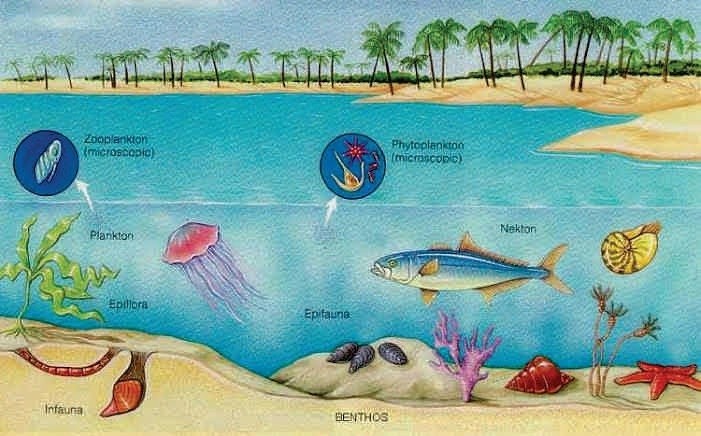
Organisms that live in the bottom zone of aquatic environment (standing or running, fresh water or marine) burrowing in the bottom mud or crawling over it or swimming or sedentary at a place are called Benthos. The bottom layer of aquatic environment where benthos are found is called the Benthic Zone. The benthic zone ranges from the shore area where water meets land, to the shallow depths and further to the extreme depths where even humans have not reached yet.
The term benthos was coined by Ernst Haeckel in 1891 and it comes from the Greek noun word that means depth (of the sea). Benthos life forms include plant forms (phytobenthos), animal forms (zoobenthos), and microbial forms (benthic microflora) that are the equivalents of primary producers, consumers, and decomposers, respectively.
Types of Benthic Organisms – Benthic organisms can be divided into three groups depending upon their habitat –
* Hyperbenthos: Those have the ability to swim and live near the bottom but are not attached to it. e.g. Clams and Mussels, Snails, Star Fish, Sea Urchin, Benthic Diatoms etc.
* Epibenthos: Those spend their lives attached to the bottom floor on rocks, or on shells etc. e.g. Corals, Sponges, Barnacles, Macroalgae, Sea Grasses etc.
* Endobenthos: Those live within the sediments in burrows or creating underground tunnels. e.g. Oligochaete worms, Tubeworms etc.
Importance of Benthos:
Benthos are very important part of aquatic food chain. Mostly benthos tends to rely on food sources that sink down to the bottom, such as inorganic matter and dead organisms, but many of them also feed on one another. Many other organisms such as fishes, aquatic birds and other aquatic organisms also feed upon benthic organisms. They act in keeping balance in the environment. They break down the dead organic matter that sinks into the water thus keeping the aquatic environment cleaned up from waste and dead & decomposing material through their feeding process. They play important role in recycling of nutrients in the aquatic environment. Benthos also acts as a bioindicator of the health of aquatic environment through their presence or absence indicating the cleanliness/pollution of the habitat.