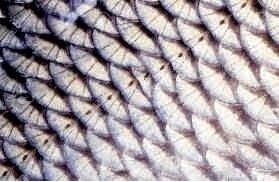
A fish scale is a small rigid plate that grows out of the skin of a fish. Fish scale is rooted and develops in the mesoderm (layer between epidermis and the underlying tissues). The term scale is derived from the Old French word escale, meaning a shell pod or husk. Primary purpose of scales is to act as armour,protective covering for fish and apart from that they help them in camouflaging through the use of reflection and coloration as well as hydrodynamic advantages. Genes responsible for the development of scales in fishes are same like that of genes responsible for development of hairs in mammals.
Scales grow on a fish in overlapping plates, in a pattern that the free end of the scale points towards the tail. If you slide your hand on the fish body from head towards tail it will feel like smooth skin whereas if you slide hand from tail towards head then free ends of scales will give you rough-textured feeling.
Fish scales are categorized in four major types – Placoid, Ganoid, Cycloid and Ctenoid.
 Placoid Scales: Placoid scales are the most primitive form of scales. They do not grow in size as the fish size increases, instead more scales are added. The structure of placoid scale has 3 layers. The innermost is the pulpy vascular core over which middle layer is calcified tissue called dentine and outermost layer made of hard glassy, opaque or partially opaque, enamel-like substance, called vitrodentine. Cartilaginous fishes like Sharks, Rays, Chimaeras etc have placoid scales.
 Ganoid Scales: Ganoid scales are slightly less primitive than placoid scales. These scales grow in size as the fish ages. The structure of ganoid scales appears like diamond shaped, hard and thick. Ganoid scale is formed from ganoine (shiny substance that is secreted by the deep vascular inner layer of the skin called corium, and composes the outer layer of the scale). Fishes like Bichir, Paddle fish, Bowfins, Gars, Sturgeons etc have ganoid scales.
 Cycloid Scales: Cycloid scales are the less advanced of the advanced scale types. These scales increase in size as the fish ages and the growth can be seen in the form of rings made in scale. The rings can be related to the age of the fish. Cycloid scales are thin, circular scales covered by a thin layer of epidermis and mucus. This gives the fish a slimy feel. Lower order bony fishes like Salmon, Carps, Minnows etc have cycloid scales.
 Ctenoid Scales: Ctenoid scales are the most advanced of all the scale forms. These scales also increase in size as the fish grows and the growth is manifested in the form scale rings. The structure of ctenoid scale is similar to cycloid scale with the exception of tiny comb-like protrusions on the posterior (free end) of the scale. These protrusions in the scale help the fish to swim faster. Higher order bony fishes like Tuna, Perch, Drum, Sunfish etc have ctenoid scales.
The structure of scales is useful in broad classification of the fish groups. Thus, among the fishes, placoid scales are characteristic of Chondrichthyes (Fishes having cartilage, tough elastic tissue), ganoid scales are found in the primitive bony fishes, while the cycloid and ctenoid scales are found in the higher teleosts (bony fishes).
Like annular rings in trees, cycloid and ctenoid fish scales also have annual growth rings. By observation of pattern of scale rings one can infer the age and growth of fish as well as environmental conditions prevailing in their habitat.