Khurpi/trovel, Soil Color Chart
(An example of soil colour chart is given here; you can use it to compare the colours of sampled soils. You can also prepare more charts of the known soil colours for further use).
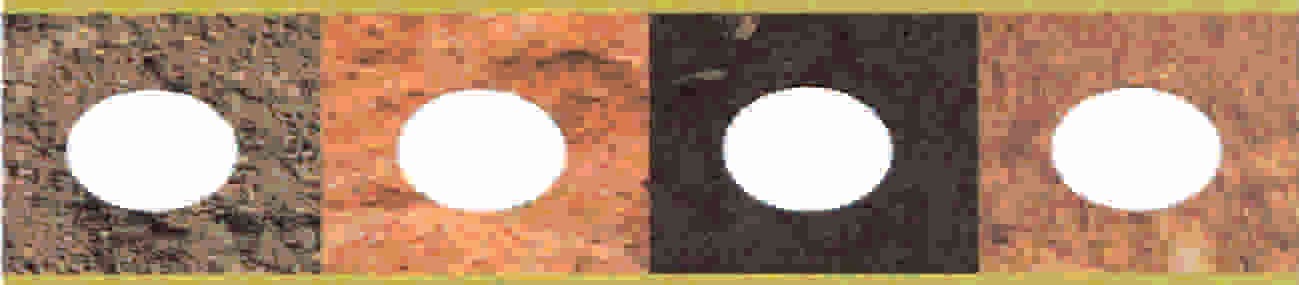
Image: Soil colour diagram
1- Collect some amount of soil from different depths (soil horizons) at one place or from different locations,
2- If the sample is dry, moisten it slightly with water,
3- Record the colour of each sample and other information of sampling site
Note: Sometimes, a soil sample may have more than one color. Record a maximum of two colors if necessary, and indicate (I) the Main (dominant) color and (II) the other (sub-dominant) color.
For reference, some soil colour categories are described here -
Black Soil: These soils are often associated with high levels of organic matter (peats) that gives them their colour. Such soil has poor pH and are characterised with having poor drainage (not allowing much water to drain down) and hence mostly show waterlogging conditions above them.
White/Pale/Bleached Soil: These soils are often referred to as bleached or 'washed out'. These soils exhibit light colour due to leaching out of nutrients like iron and manganese due to high amount of rainfall or heavy drainage. They are characterised with poor organic contents and leached nutrients.
Red Soil: Red colour soils indicate good drainage. The red colour is because of oxidization of iron content within the soil due to oxygen rich conditions. This causes the soil to develop a 'rusty' colour. The colour can become darker with organic matter. This soil is rich in essential nutrients like phosphorus, iron and potassium and is considered fertile and good for agriculture.
Yellow to Yellow-Brown: These soils have thin A horizon and are characterised with low pH and low level of oxides. This soil has more aluminium and iron than silica. The iron compounds in these soils are much in a hydrated form and therefore instead of producing rusty colour they exhibit yellow or yllow-brown colour. These soils have poor organic content and nutrients like phosphorus, therefore not very fertile.
Brown Soil: These soils are characterised with good amount of decaying organic matter along with minerals like iron oxide and silica. The darkness of brown colour varies with amount of organic content and drainage of water and so as the fertility.
Gleyed / Grey/ Green Soil: These soils are associated with waterlogging or poor drainage. Prolonged waterlogging and lack of air in these soils provides conditions for iron and manganese compounds to get reduced (that is responsible for the colour of soil). The iron and manganese compounds are either get removed from soil or get segregated as mottles or concretions in the soil.
â— For each sample record the colour of the soil and other details like location (latitude & longitude), date & time, land use type, etc.
â— In case you come across a new soil color, you can make your own soil colour category to record the observation (also continue your search through reference material and web resources to know more about that coloured soil).
â— For compilation and tabulation of data a sample table as an example is given here, you can design your data table accordingly.
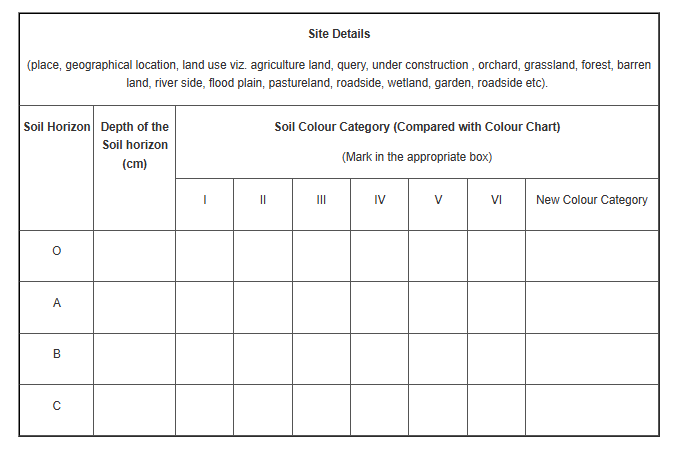
â— You can simply find out how many colour types of the soils are found in the referred area. Their external features and conditions can be understood.
â— After getting the basic data you can do mathematical and statistical calculations to draw appropriate results and conclusion.
â— Identification of soils on the basis of their colours and associated features.
â— Skills of sampling, collection, observation, comparison and referencing with standards regarding color characteristics which are key tools for scientific explorations.
â— Plastering and colouring of houses, palaces and other objects with different colour soils is practiced from ancient times. Even in many tribal communities the colouring sense is very excellent. How those people do were able to prepare permanent colours using soils?
Munsell Color System: It is a method of designating colours on the basis of a colour scheme. The scheme is based on three qualities or attributes namely Hue, Value & Chroma (HVC):
â— Hue – It corresponds to the dominant wavelength of color such as red, orange, yellow, etc;
â— Value – It corresponds to the brightness (lightness or darkness) of a color;
â— Chroma – It corresponds to the saturation or brilliance of a color.
In the Munsell colour tool a collection of colour chips having varying degrees of hue, value and chroma is given and one can match the sample colour with the given colour chip and it’s corresponding code.
For further details about Munsell Color System you may refer to the website https://munsell.com