An aquarium may serve as an aquatic ecosystem where the captivated aquatic plants and animals stay comfortably under the optimal conditions and even can reproduce and perform lifecycle activities and interactions. One can easily see through an aquarium how various aquatic organisms distribute in different zones of water according to their microhabitat preference, how they use their body parts in different activities, their adaptive features, behaviour etc for the desired duration.
Here with the example of an aquarium as an ecosystem we can understand its components including producers, consumers, their interactions, food chain, food web, energy transfer, trophic structure, biogeochemical cycles etc that are characteristic features of an ecosystem.
We can make an aquarium of any size, even from one cubic feet to several cubic meters or more, in variable shapes, according to the available space to keep and ability to manage.
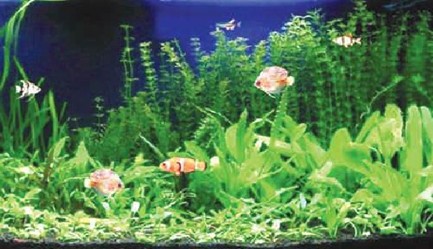
View of an Aquarium
â— You can make an aquarium of glasses bound with each other. Alternatively, you can find prepared aquariums in the market. You can make a small aquarium using a glass container available at home. You can also take any box type container whose one side at least should be transparent.
1- Take an aquarium and cover its top open side with a gauzed cloth or a thin mesh like mosquito net such that you can open it at requirement.
2- Lay some gravel and coarse sand at the bottom of the aquarium.
3- Fill the aquarium with normal water (better collected from a river or a pond or lake and if not available then tap water will also work), leave it for few hours so that suspended particles in the water will settle down.
4- Fix some aquatic plants at the bottom of the aquarium (there might be free floating plants as well and you can put them as well).
5- Release the aquatic organisms in the aquarium carefully.
6- Observe the aquatic animals for the desired duration and record the observations.
â— Data collected through observation may be recorded in the tabular form or in descriptive form.
â— The data may be analysed quantitatively and/or qualitatively or in the narrative form in reference to a particular organism or different classes of organisms or as a whole.
â— You can record different ecosystem functions of the organisms and also the ecosystem services of the aquarium (aquatic) ecosystem.
â— Present your data / observations in the basis of calculations or qualitative analysis in reference to species diversity, microhabitat requirements, behaviour, functions etc.
â— Understanding of an aquatic ecosystem from a well-managed aquarium.
â— Distribution, zonation, feeding pattern and other activities of different aquatic organisms differ species-wise as well as individually.
â— Aquatic organisms have different morphology and adaptations to live in the aquatic environment.
â— Can you keep marine fishes in an aquarium? For that, what type of conditions you will have to make?
â— What do fishes deliver in reproduction – eggs or juveniles? Can you identify fishes in your area accordingly?
â— How do fishes take care and nurture their offspring? Watch and describe.
Marine World – India’s Largest Public Aquarium
India’s largest marine aquarium 'Marine World' was opened in on 21st August, 2023 at the shores of the Panchavadi Sea in Chavakkad in Thrissur district of Kerala state. The marine aquarium houses more than 3 lakh fishes from 300+ species of oceanic life. The largest public aquarium is expanded on four acres of land that can normally occupy 150+ visitors at a time and up to 2000 people on holidays.