A solar eclipse occurs when the Moon passes between the Sun and Earth, casting a shadow on Earth that partially or completely blocks the sunlight in some areas. Solar eclipses are classified into total, annular, partial and hybrid types according to the position of the Moon between the Sun and Earth.
Watching the solar eclipse directly with naked eyes is harmful because the direct solar radiations may cause serious injurious to eyes. Even it is not safe to watch solar eclipse using a camera lens, telescope, binocular or any optical device because the concentrated solar rays will cause severe injuries to eyes or even loss of vision. Therefore it is recommended to watch solar eclipse through indirect viewing methods.
Here we are helping you to watch solar eclipse safely using simple handy devices without any direct watching. Here two simple techniques namely, Pinhole Projection and Plain Mirror Projection are described that are easy to assemble and also easy to be used in watching the Solar eclipse.
Pin-hole Projection: In this technique the sunlight is passed through a small opening (just by crossing your fingers or by a hole punched in a paper or card) and is projected onto a nearby surface. There are different ways of making the pinhole projector, either using a plain card or paper or a cardboard box.
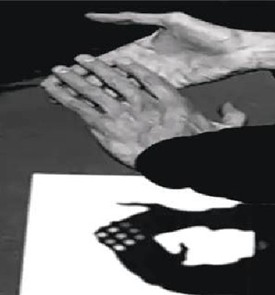
Figure: Creating Pinhole by Overlapping Fingers (Source – Times of India)
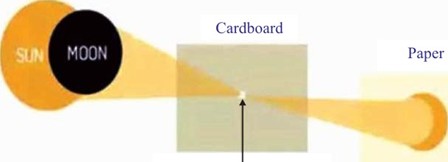
Figure: Simple Pinhole Projector made of Cardboards (Source – Times of India)
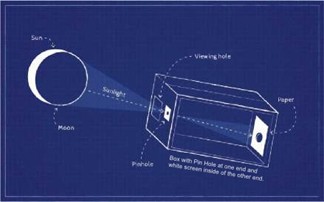
Figure: Box Type Projector (Source - Toronto Star Graphics)
Under the mirror projection a plain mirror is covered with a black paper sheet having a small hole at the centre. The sunlight falling on the mirror projector is reflected only from the centre hole and the solar image is focused onto a nearby surface.
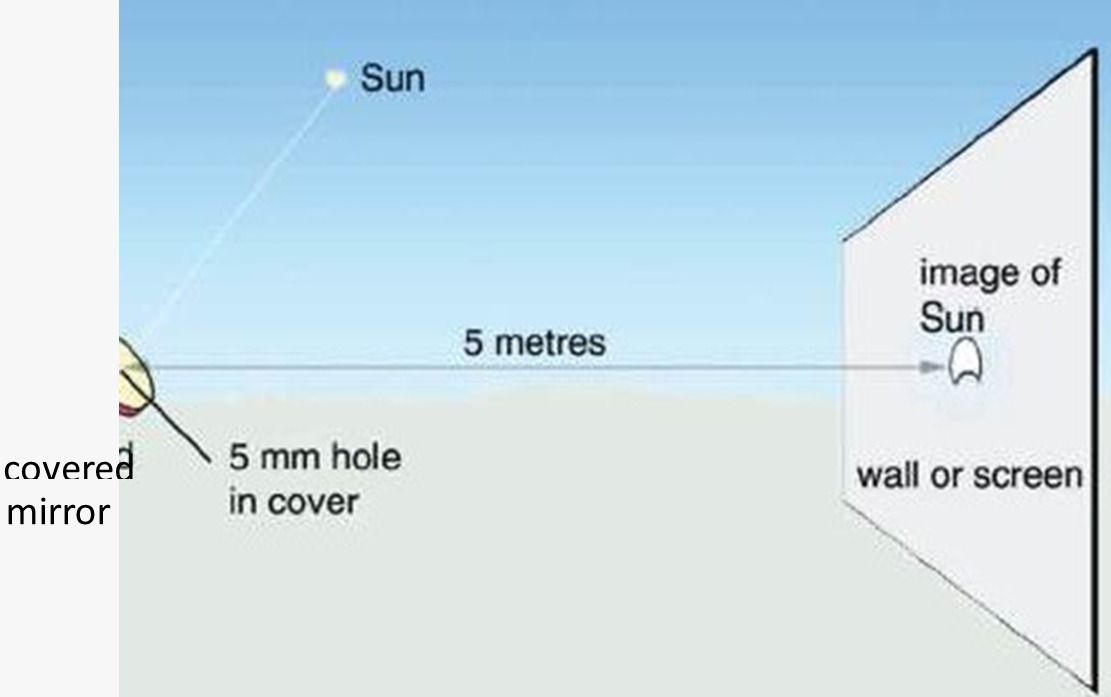
Figure: Diagram of Using Mirror Projector (Source – Times of India)
Plain card or thick paper sheet, cardboard box, plain mirror, black paper sheets
Pin-hole projector Making -
A. Take a card or thick paper and make a small hole of 1-2 mm diameter at its center (alternatively, you can take a cardboard box and at its one side make a small hole of 1-2 mm diameter. B. When pinhole side is oriented towards the sun, the sunlight enters through it and, in the box the reversed image of the sun is formed on the inside wall of the opposite end, whereas if a card or thick paper is taken then the projected image may be formed on the ground or on the wall.
Plain Mirror Projector Making -
A. Take a plain mirror and cover it with a black sheet of paper which has a hole of 1-2 centimeter diameter at the centre. The sunlight falling on the mirror is reflected only from the hole of black paper and its reflection can be focused on a wall or ground surface, based on the angle of falling sunlight.
Method-1 (Pin-hole Projector):
1- In case of a box type pinhole projector, align the projector such a way that its pinhole side faces towards the sun and the opposite end faces the ground.
2- In case of the card/paper projector, place a black paper on the ground and align the pinhole projector such that it points towards the black paper (this way you will be able to see the Sun’s reflected image more clearly).
3- Carefully observe the projected image of the Sun formed on the black paper.
4- You can fix the device before the start of eclipse and record the time and change in the projected image of the sun till the end of eclipse.
Method-2 (Plain Mirror Projector):
1- Take the plain mirror projector and orient it towards the sun such a way that the sunrays falling on its centre hole are reflected on a dark surface.
2- Carefully observe the projected image on the dark surface and record the change in the projected image during the eclipse period with a time scale.
3- Both of the above methods may be carried out by an individual or in a group. In fact, both methods can be used for the public demonstration of the ongoing solar eclipse.
â— You can mark the progression of the eclipse on the paper with a pencil or marker at the regular time interval (i.e. phases of eclipse at time scale), alternatively you can use a paper marked with the time scale.
â— The sketch of the eclipse phase along with time scale may be drawn on the white paper for the record and further interpretation.
â—The eclipse phase may be recorded in the tabular tool. A sample table is shown here, you can make your own data table according to need.
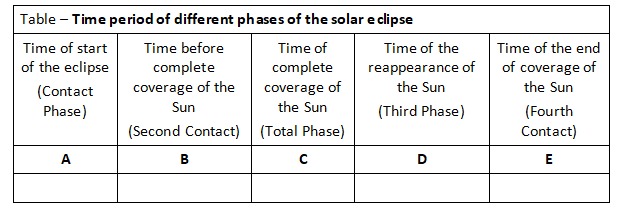
â— You can calculate the total time period of the eclipse by deducting time of start (A) from time of end (E) and can record the total time period of the eclipse in minutes or hours.
â— Similarly, you can calculate time interval between different phases of the eclipse.
You can present your observation on the eclipse time period and duration of different phases and make inferences accordingly. You can also determine the best distances where reflected sunlight from the pin-hole or mirror-hole makes clear images on the ground or the surface
â— You will be able to watch the solar eclipse by alternative means without directly watching the Sun.
â— You can make the tools described in this activity yourself to watch the solar eclipse.
â— Common masses may also be demonstrated the live solar eclipse, to watch & understand the celestial phenomenon.
â— Learners will be able to watch and record the eclipse; by doing this they shall be able to derive various inferences about the eclipse phase, its time scale, stages of the eclipse.
â— Does our biological cycles and behavior get influenced with the solar eclipse? You may try observing behavior of other organisms (including certain plants) during the eclipse phase.
â— Is it possible to make a pin-hole or mirror projector from metallic items or from other alternative materials?
â— Why it is said not to have food or do outside activities during the solar eclipse?
Watching the solar eclipse directly is harmful?
There are different concerns regarding watching the solar eclipse. Because of the high energy radiations of the Sun, watching the sun directly with naked eyes or through telescope or plain glass may lead to permanent injury to the retina of eye or even blindness. The intensity of solar radiations increases during the solar eclipse and watching it directly by any means may lead to severe injuries or/and blindness.
Diamond Ring during Solar Eclipse!
Diamond Ring or the ‘Baily's Bead Effect’ occurs at two times during the total eclipse phase, i.e. just before the complete coverage of the sun and just when the complete coverage ends up. During diamond ring stage last bits of sunlight pass through the valleys on the moon's limb, and the faint corona around the sun becomes visible. The faint corona looks like a ring with glittering diamonds on it.