Butterflies are hyperactive insects that keep on flying and moving during daylight. Hence it is very difficult to observe them closely at a static position. One can easily catch butterflies with the help of butterfly net and can keep them in the terrarium for observation along with providing basic requirements fulfilled such as fresh air, water, food and security. After observing and studying the butterfly it is released back into its natural environment.

A butterfly net
v The butterfly net consists of a metallic or wooden handle with removable or fixed rugged metallic ring or wire hoop. An elongated mesh bag (usually made of nylon) is attached to the ring in a manner that its broad mouth is fixed to the ring/hoop and the elongated part ends in a narrowing closed distal end. To catch the butterfly the net is swung in the air such that the flying butterfly is caught in the mesh bag without causing any harm to its body.
1- First assemble the butterfly net and practice is how to use it.
2- Hold the handle and move the face of the net in a horizontal manner in one direction.
3- Always keep in the mind that the butterfly is moving in front of you and you are moving the net towards the butterfly in a careful manner so that you manage to catch the butterfly without causing any harm to it.
4- Once the butterfly gets inside the net, slowly lock the face of the net by rotating the handle of the net. This does not allow the butterfly to come out of the net.
5- Take an appropriate size container to transfer the butterfly into it from the net.
6- Transfer the butterfly to the terrarium.
7- Once the butterfly finds air, water, food and security inside the terrarium and moves freely inside the terrarium, start your observations in systematic manner and record in the data format.
8- After observing for the desired time, release the butterfly back to its natural habitat.
9- .Make sketches of butterflies and if possible take their photographs as well for display.
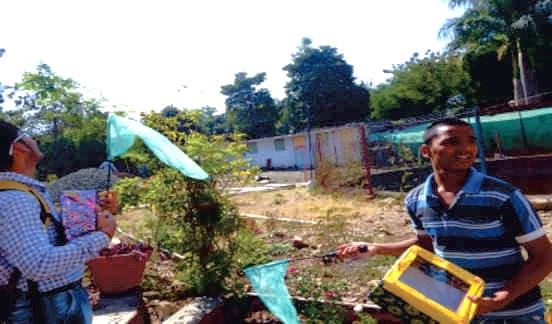
â— You can catch and study a wide range of butterflies and make records of their morphology, behavioral pattern in a systematic manner.
â— Comparative analysis of the collected information can be used to make numerical inferences and illustrative records like charts and posters.
Record your observations systematically in a data format. An example of data table is given here; you can design your own data table according to the need.
â— You can present your observations in the form of quantitative and/or qualitative data.
â— Hand drawn sketches and photographs will be an additional record to display.
â— Butterfly net is an easy tool to catch butterflies without harming them.
â— Butterflies also sit and rest on different objects and surfaces besides doing their diurnal activities.
â— Different species of butterflies have different types of morphology and body coloration.
â— Butterflies also possess sexual dimorphism and by practice one can distinguish male & female of a species.
â— How do butterflies identify colours of flowers and plants?
â— Why not butterflies seen in the night? Are they night-blind or else?
What is Butterfly Stroke?
The ‘butterfly stroke’ is a swimming stroke swum on the chest, with both arms moving symmetrically, accompanied by the butterfly kick along with the movement of the hips and chest. This style evolved in the early 1930s and while performing the breaststroke style. If you look at the arm (wings) and leg movements of a mature butterfly, you’ll see the arms (wings) make a semicircular motion in the front on the sides of the body, and the legs make the same motion at the rear on the sides of the body. Those semicircles look like butterfly wings.