Rainfall is an inevitable parameter to understand the weather and climate of an area and the simplest tool to monitor rainfall is the Rain Gauge. The rain gauge consists of a cylindrical jar, a funnel and a graduated measuring cylinder. The cylindrical jar is placed on a flat surface and the measuring cylinder is placed in it and the funnel is fitted on top of the jar such that its tubular end hangs in the measuring cylinder. The funnel acts as the collector and collects the rain water which is falling over its area and the collected water is stored in the measuring cylinder. Later on, the collected rain water is measured in height (millimeter).
A standardized design of rain gauge is used throughout the world for rainfall measurement, and according to that the funnel of 203 mm (20.3 cm or 8 inch) diameter is used. But if you are using the funnel of another diameter then you have to calibrate it accordingly. Normally 1 mm of rainfall (collected in the graduated cylinder) is equivalent to 1 liter of rain water volume per square meter area. One can easily assemble own rain gauge with the locally available material.
The amount of rainfall is expressed in millimeter (mm) and is normally measured for 24 hrs for calculation. With average annual rainfall of an area (i.e. total rainfall in a year) one can estimate the potential of rain water collection in reference to any built area or an open area.
Rain gauges can be installed at any place having area of at least 5 to 10 meters diameter open around it. The more open place, the better it is.
â— Rain gauge assembly (cylindrical jar, funnel, measuring cylinder), note book, pen/pencil
1- Dry the cylindrical jar and keep it on a flat surface in an open space,
2- Fix the funnel on top of the cylindrical jar,
3- Leave the set up for 24 hours rainfall collection,
4- After 24 hours, take the funnel out and pour carefully the water collected in the jar directly into a measuring cylinder,
5- Record the reading of water level in the measuring cylinder in millimeter (mm),
6- Calculate the rainfall in mm for the sampling period,
7- Dry the cylindrical jar and keep it for recording of rainfall for the next 24 hours.
● If you have made a local rain gauge taking the funnel (collector) of different diameter then you will have to calibrate it as follows –
● Radius of your rain gauge collector (funnel) – ‘r’ cm
● Area (A) of the mouth of your collector = π r2 i.e. 3.14 X r2 (suppose A cm2)
● rea (B) of the collector of standard rain gauge (having 203 mm or 20.3 cm diameter or 10.15 cm radius) = π r2 i.e. (3.14 X 10.5 X 10.5) = 323.65 cm2
● Multiplying factor for your rain gauge (F) = B/A
● Calculate the amount of rainfall measure in your rain gauge = water collected in measuring cylinder X F (mm)
●. Suppose the collector in your rain gauge has a diameter of 123 mm which corresponds to an area of 119 sq. cm. The collector of 119 sq.cm area has to be calibrated against the standard funnel of 203 mm (323.65 sq cm area). Hence the rainfall measured in your rain gauge has to be calculated by multiplying with a factor of 2.72.
● Suppose the reading of rainfall in your rain gauge is measured 9 mm then the actual reading will be calculated as follows -
Rainfall (mm) reading in the measuring cylinder × 2.72
This will be 9 X 2.72 = 24.5 mm
For record of the rainwater collected in the rain gauge and calculation of the rainfall you may design a data table. A sample data table and sample calculation is given here –
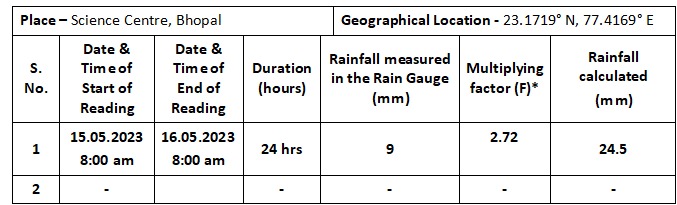
The daily or monthly or yearly rainfall data can be presented in simple tabular form or as per need. Various interpretations of rainfall can be done through mathematical and statistical calculations.
● Amount of rain fall in an area can be measured using the rain gauge.
● Record of amount of rainfall over a rainy season in a year will help to find out how much it rained in different parts of the season.
● Record of amount of rain fall in several years will help to understand the pattern of rain fall in different years.
● A comparison of rain fall data over a period can educate us about the change of pattern of rain fall in different seasons. This can also be correlated with the change of other ecological factors related to the rain fall to understand the impact of rain fall on ecology in a particular area.
● What is Rainwater Harvesting? How do you find the rainwater harvesting potential of your house?
● Rainwater can be considered like distilled water, True or False? Give reason in support of your answer.
● Why it is not recommended to bath in the first rain?
● Normally we see rainbow during the rainy season. Why can’t we see it throughout the year?