Soil consistency is soil’s expression of resistance to pressure and rupture, as well as it's stickiness and plasticity. Different kinds of soils possess the strength with which soil materials are held together or the resistance to deformation. We can check the soil consistency simply by pressing it to rupture or get deformed. Feel of the soil consistency can be recorded as loose friable, firm, hard etc which is reflecting relative resistance to the applied pressure.
By doing this activity one can understand the differentiation between strength of soils found in different landscapes as well as soil found in different soil profiles (horizons). This also helps in decision making for preparation of soil appropriately before using it for any purpose.
â— Leaflet of figures to test soil consistence
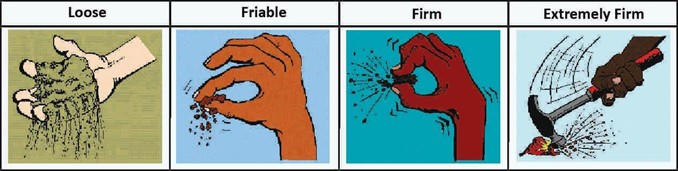
1- Take a ped from any soil horizon.
(If you are collecting the soil from top surface you may not dig the soil but if you are collecting the soil from different horizons then you have to dig the earth to see the soil profile. If the soil inside is very dry then moisten the face of the profile with mild spray of water using a water bottle and then remove a ped to determine the consistency).
2- Holding the ped in between your thumb and forefinger, gently squeeze the ped until it pops or falls apart.
3- Record one of the following categories of soil consistency in the data sheet -
â— Loose Soil- Trouble in picking out a single ped and the structure falls apart before it is taken out. Soils with single grained structure (in which individual particles do not stick together) always have loose consistence. For example, sandy soil is always a loose soil.
â— Friable Soil- The ped breaks with a small amount of pressure.
â— Firm Soil- The ped breaks when you apply heavy pressure that even cause dents on your fingers.
â— Extremely Firm- The ped can't be crushed with your fingers (you need a hammer).
â— Repeat this procedure for each horizon/profile in your area.
You may record the soil consistence type of different soil profiles (horizons). A sample table is given here, you may design your own data sheet/table to record your observations as per need.
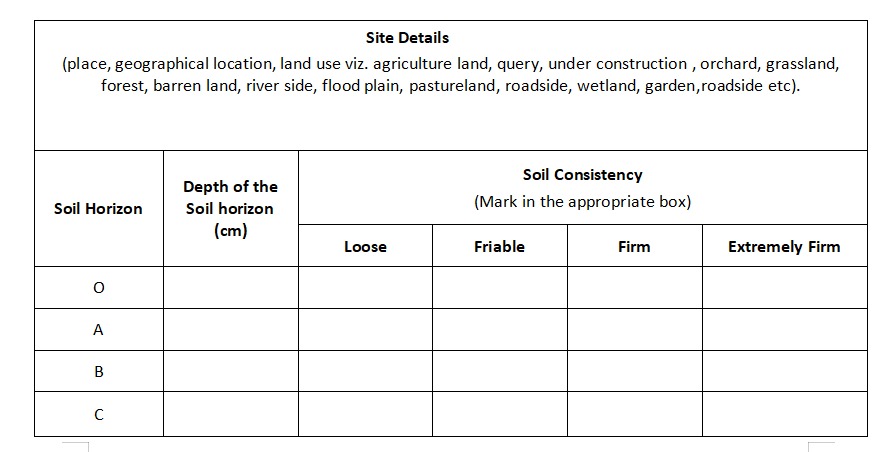
â— Present your results in the form of numerical data and/or in the form of qualitative description. Various interpretations can be done through mathematical and/or statistical calculations.
â— Photographic evidences of the landscape surrounding the sampling site will be useful for further reference.
â— Observations of soil types, their horizons and consistency and their interrelationships.
â— Categorization of soil types based on a certain criteria. For example, soil consistency of own area.
â— Understanding why preparation of soil is important before its use for a purpose.
â— Take seeds of your local cereals or plant varieties and try growing them in different soil (consistence) types.
â— Try preparation of soil by mixing of soils of different consistence and experiment the seed germination in that and other tests of soil characteristics.