In a ponds or other water bodies viewing the aquatic life forms is not easy due to various factors such as turbidity of water, continuous movement of the animals, hiding spaces inside water and also the distance of viewer (eye) from the water level.
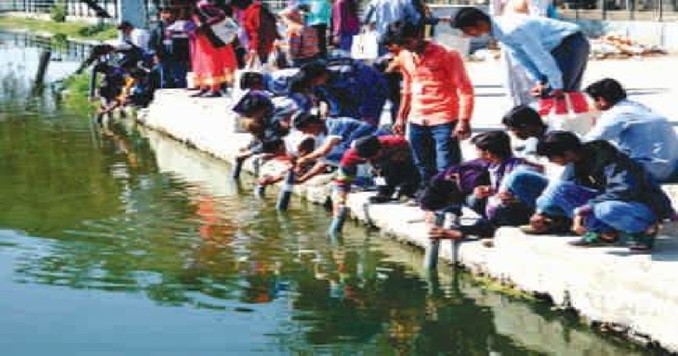
Viewing tube is the simple device that enables a person to look inside shallow water and watch different life forms distributed in it from surface to bottom. Viewing tube is a cylindrical narrow tube having 2-3 inch diameter and length appropriate to dip it up to few feet under the water. Its one end (which is dipped inside water) is closed with transparent film or glass and the other end open outside water where the observer can fix eye and see the underwater objects. Efficiency of the viewing tube can be further strengthened by attaching a convex lens at the dipping end which would further magnify the view of the objects being seen. Additionally, an LED light may also be attached to the dipping end. The LED light may be used for viewing underwater during night hours or if the water is much turbid.

Viewing tube
1- Dip the viewing tube in the water and move it down slowly and steadily so that the aquatic animals do not feel disturbed by the movement of the tube.
2- Once the dipped end reaches at a depth you decide or any animal or a plant is seen, stop further lowering of the viewing tube.
3- From the open end outside, see through the viewing tube in the water and observe the objects carefully.
4- By lowering the viewing tube further down you can stop at any point to see the objects inside the water.
5- Reach up to the bottom to see the bottom life forms and deposits and structures.
6- Move the viewing tube horizontally or slightly oblique to see underwater in different directions.
7- You may catch the planktons and other small plants and animal forms with the help of plankton net or tea strainer and bring them to home and put them in aquarium for further observations.
8- Note down your observations in the data tool.
You can present your data in tabular form or other form. A sample of data table is given here; you can design your own data table according to need.

â— You can present species lists of plants and animal life forms and their taxonomic classes.
â— Distribution of different life forms in the aquatic habitat may be explained.
â— Description of nature and behavior of aquatic animals and plants may be given so it can provide insights about their habitats and inter-relationships.
â— Viewing tube is a simple and effective way to go closure to the aquatic animals and plants and study their body structure, behavior and living styles.
â— Underwater life forms are diverse and they are distributed in different zones of water making their microhabitats.
â— Observations of aquatic life forms at different time of the day give us more information about their diurnal behaviour.
â— Is it possible to use viewing tube to see underwater in open waters of ponds / lakes / reservoirs / sea / rivers? If yes, explain how and if not then explain why not.
â— What will be the behaviour of aquatic life forms in presence or absence of light?
â— Also it will be interesting to study how animals respond to the presence of the approaching tube inside water.